Block Chain
The following subsections briefly document core block details.
Block Headers
Block headers are serialized in the 80-byte format described below and then hashed as part of ReddCoin’s proof-of-work algorithm, making the serialized header format part of the consensus rules.
| Bytes | Name | Data Type | Description |
|---|---|---|---|
| 4 | version | int32_t | The block version number indicates which set of block validation rules to follow. See the list of block versions below. |
| 32 | previous block header hash | char[32] | A SHA256(SHA256()) hash in internal byte order of the previous block’s header. This ensures no previous block can be changed without also changing this block’s header. |
| 32 | merkle root hash | char[32] | A SHA256(SHA256()) hash in internal byte order. The merkle root is derived from the hashes of all transactions included in this block, ensuring that none of those transactions can be modified without modifying the header. See the merkle trees section below. |
| 4 | time | uint32_t | The block time is a Unix epoch time when the miner started hashing the header (according to the miner). Must be strictly greater than the median time of the previous 11 blocks. Full nodes will not accept blocks with headers more than two hours in the future according to their clock. |
| 4 | nBits | uint32_t | An encoded version of the target threshold this block’s header hash must be less than or equal to. See the nBits format described below. |
| 4 | nonce | uint32_t | An arbitrary number miners change to modify the header hash in order to produce a hash less than or equal to the target threshold. If all 32-bit values are tested, the time can be updated or the coinbase transaction can be changed and the merkle root updated. |
The hashes are in internal byte order; the other values are all in little-endian order.
An example header in hex:
02000000 ........................... Block version: 2

b6ff0b1b1680a2862a30ca44d346d9e8
910d334beb48ca0c0000000000000000 ... Hash of previous block's header
9d10aa52ee949386ca9385695f04ede2
70dda20810decd12bc9b048aaab31471 ... Merkle root

24d95a54 ........................... [Unix time][unix epoch time]: 1415239972
30c31b18 ........................... Target: 0x1bc330 * 256**(0x18-3)
fe9f0864 ........................... Nonce
Block Versions
- Version 1 was introduced in the genesis block (January 2009).
- Version 2 was introduced in ReddCoin Core 0.7.0 (September 2012) as a soft fork. As described in BIP34, valid version 2 blocks require a block height parameter in the coinbase. Also described in BIP34 are rules for rejecting certain blocks; based on those rules, ReddCoin Core 0.7.0 and later versions began to reject version 2 blocks without the block height in coinbase at block height 224,412 (March 2013) and began to reject new version 1 blocks three weeks later at block height 227,930.
- Version 3 blocks were introduced in ReddCoin Core 0.10.0 (February 2015) as a soft fork. When the fork reached full enforcement (July 2015), it required strict DER encoding of all ECDSA signatures in new blocks as described in BIP66. Transactions that do not use strict DER encoding had previously been non-standard since ReddCoin Core 0.8.0 (February 2012).
- Version 4 blocks specified in BIP65 and introduced in ReddCoin Core 0.11.2 (November 2015) as a soft fork became active in December 2015. These blocks now support the new
OP_CHECKLOCKTIMEVERIFYopcode described in that BIP.
The mechanism used for the version 2, 3, and 4 upgrades is commonly called IsSuperMajority() after the function added to ReddCoin Core to manage those soft forking changes. See BIP34 for a full description of this method.
As of this writing, a newer method called version bits is being designed to manage future soft forking changes, although it’s not known whether version 4 will be the last soft fork to use the IsSuperMajority() function. Draft BIP9 describes the version bits design as of this writing, although it is still being actively edited and may substantially change while in the draft state.
Merkle Trees
The merkle root is constructed using all the TXIDs of transactions in this block, but first the TXIDs are placed in order as required by the consensus rules:
- The coinbase transaction’s TXID is always placed first.
- Any input within this block can spend an output which also appears in this block (assuming the spend is otherwise valid). However, the TXID corresponding to the output must be placed at some point before the TXID corresponding to the input. This ensures that any program parsing block chain transactions linearly will encounter each output before it is used as an input.
If a block only has a coinbase transaction, the coinbase TXID is used as the merkle root hash.
If a block only has a coinbase transaction and one other transaction, the TXIDs of those two transactions are placed in order, concatenated as 64 raw bytes, and then SHA256(SHA256()) hashed together to form the merkle root.
If a block has three or more transactions, intermediate merkle tree rows are formed. The TXIDs are placed in order and paired, starting with the coinbase transaction’s TXID. Each pair is concatenated together as 64 raw bytes and SHA256(SHA256()) hashed to form a second row of hashes. If there are an odd (non-even) number of TXIDs, the last TXID is concatenated with a copy of itself and hashed. If there are more than two hashes in the second row, the process is repeated to create a third row (and, if necessary, repeated further to create additional rows). Once a row is obtained with only two hashes, those hashes are concatenated and hashed to produce the merkle root.

Example Merkle Tree Construction TXIDs and intermediate hashes are always in internal byte order when they’re concatenated, and the resulting merkle root is also in internal byte order when it’s placed in the block header.
Target nBits
The target threshold is a 256-bit unsigned integer which a header hash must be equal to or below in order for that header to be a valid part of the block chain. However, the header field nBits provides only 32 bits of space, so the target number uses a less precise format called “compact” which works like a base-256 version of scientific notation:

Converting nBits Into A Target Threshold As a base-256 number, nBits can be quickly parsed as bytes the same way you might parse a decimal number in base-10 scientific notation:
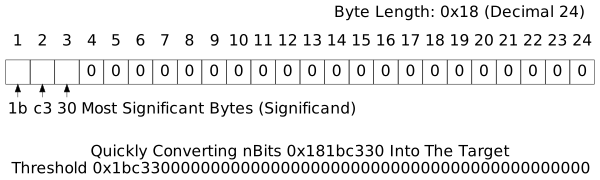
Quickly Converting nBits Although the target threshold should be an unsigned integer, the original nBits implementation inherits properties from a signed data class, allowing the target threshold to be negative if the high bit of the significand is set. This is useless—the header hash is treated as an unsigned number, so it can never be equal to or lower than a negative target threshold. ReddCoin Core deals with this in two ways:
- When parsing nBits, ReddCoin Core converts a negative target threshold into a target of zero, which the header hash can equal (in theory, at least).
- When creating a value for nBits, ReddCoin Core checks to see if it will produce an nBits which will be interpreted as negative; if so, it divides the significand by 256 and increases the exponent by 1 to produce the same number with a different encoding.
Some examples taken from the ReddCoin Core test cases:
| nBits | Target | Notes |
|---|---|---|
| 0x01003456 | 0x00 | |
| 0x01123456 | 0x12 | |
| 0x02008000 | 0x80 | |
| 0x05009234 | 0x92340000 | |
| 0x04923456 | -0x12345600 | High bit set (0x80 in 0x92). |
| 0x04123456 | 0x12345600 | Inverse of above; no high bit. |
Difficulty 1, the minimum allowed difficulty, is represented on mainnet and the current testnet by the nBits value 0x1d00ffff. Regtest mode uses a different difficulty 1 value—0x207fffff, the highest possible value below uint32_max which can be encoded; this allows near-instant building of blocks in regtest mode.
Serialized Blocks
Under current consensus rules, a block is not valid unless its serialized size is less than or equal to 1 MB. All fields described below are counted towards the serialized size.
| Bytes | Name | Data Type | Description |
|---|---|---|---|
| 80 | block header | block_header | The block header in the format described in the block header section. |
| Varies | txn_count | compactSize uint | The total number of transactions in this block, including the coinbase transaction. |
| Varies | txns | raw transaction | Every transaction in this block, one after another, in raw transaction format. Transactions must appear in the data stream in the same order their TXIDs appeared in the first row of the merkle tree. See the merkle tree section for details. |
| Varies | block_sig | char[] | Block signature (vchBlockSig). In PoS blocks, a DER-encoded ECDSA signature proving the block was produced by the staker. Empty in PoW blocks. See Block Signature below. |
The first transaction in a block must be a coinbase transaction (for PoW blocks) or a coinstake transaction (for PoS blocks) which should collect and spend any transaction fees paid by transactions included in this block.
ReddCoin transitioned from Proof of Work to Proof of Stake Velocity (PoSV) at block 260,800. Under PoSV, stakers earn a 5% annual reward (COIN_YEAR_REWARD) based on the coin age of their staked inputs. The coinbase maturity period is 30 blocks, after which staking rewards can be spent.
Together, the transaction fees and staking reward are called the block reward. A coinstake transaction is invalid if it tries to spend more value than is available from the block reward.
Block Signature
In PoS blocks (block 260,800 onward), a DER-encoded secp256k1 ECDSA signature (vchBlockSig) is appended after the last transaction in the serialized block. This signature is separate from transaction signatures and proves the block was produced by the owner of the staking key. PoW blocks (block 0--260,799) have an empty block signature.
Signing (block production):
- The staker identifies the private key from the coinstake transaction's first input (
vin[0].prevout), by looking up the previous output's script. - The block header hash (
GetHash()) is signed with that private key using ECDSA. - The DER-encoded signature is stored in
vchBlockSig, serialized after the last transaction in the block.
Verification:
- The public key is extracted from the coinstake transaction's second output (
vout[1]), which is a P2PK script. - The signature in
vchBlockSigis verified against the block header hash using that public key.
The block header hash covers the header fields (version, previous block hash, merkle root, timestamp, difficulty target, nonce) but does not include vchBlockSig itself.
An example block signature:
46 ...................................... Signature length: 70 bytes
| 30440220030dbb2898141fe53ea088a290
| 0569d9de18ce7df219d055ec19134e5164
| 078102207e3bd561d6f3f028cf7751f718
| b6f0cc217767370c19afb4207447ae8746
| 8be2 .................................. DER-encoded ECDSA signature